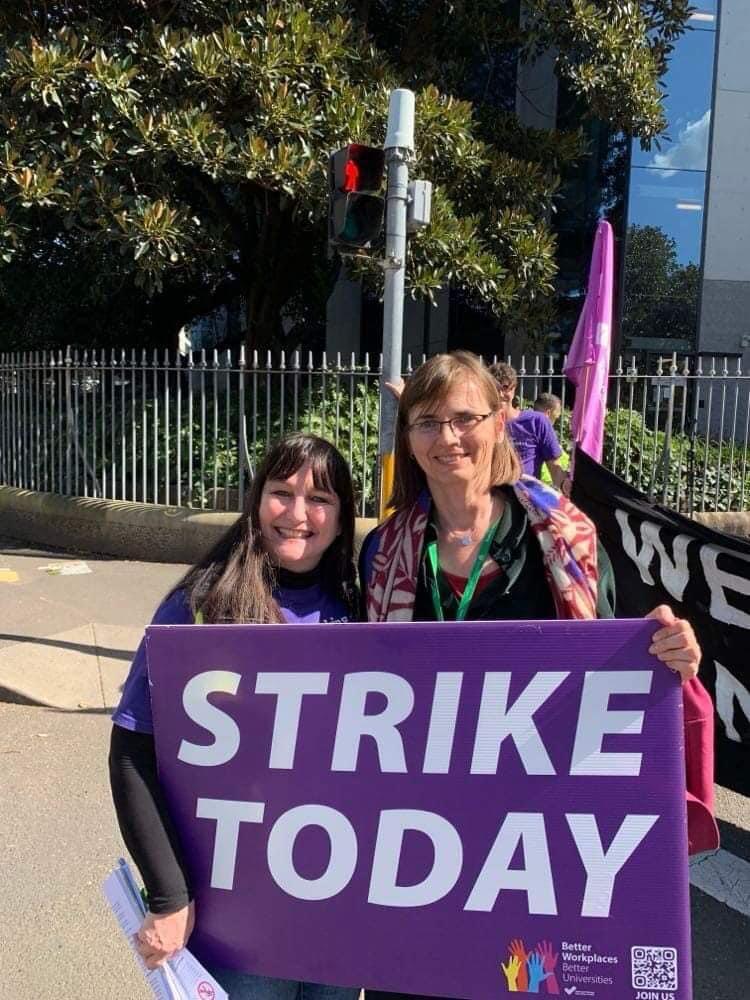
Why Casuals Should Join the NTEU

Many casuals are reluctant to join the union. Many of us are on low wages and all of us are on insecure contracts.

But union membership is worthwhile even and especially in these conditions. It pays for itself, and more importantly is the only chance we have of changing our conditions of work. This page compares casual fees with union-won pay increases, details some wins we have already had, and why we should fight for more.

Current casual fees are:

Earning <20k$3.99 per fortnight
Earning 20-30k$5.98 per fortnight
Earning 30-50k$7.97 per fortnight
Earning 50k+$9.97 per fortnight

Remember these are also tax deductible. These fees are the lowest union fees in the country: lower than those paid by McDonalds workers in RAFFWU or aged care workers in the HSU.

How do fees compare to union-won pay rises?

The NTEU USYD branch won 4.6% a year ago and 3.75% this year. 

If you were on a wage of $15,000 per annum, then this means you are on average $50 per fortnight better off in 2024-25 than the status quo.

If you were on $30,000 per annum, then this $100 per fortnight better off for 2024-25.

The latest ABS data tell the same story: union membership pays for itself.

Other wins

Union members sacrificed their pay and efforts during the EA to win improvements to casual conversion rights, 5 days per annum of casual sick pay, and 330 new academic jobs, as well as standing up for the rights of First Nations and transgender workers. Many casuals don’t even know about the 4 hours of admin hours you get per year for familiarising yourself with policy, which you can claim with the comment “GEN-EA CLAUSE 68”.

What do you do when you experience wage theft or have your contract terminated?

When casuals run into issues, such as not getting rehired, it’s important they are already members so that the union can represent them. Union policy is that non-members cannot join and immediately request help about pre-existing issues, as this runs against the collective purpose of being in a union.

Political and Ethical Reasons:

There’s a strong argument for being a part of the collective organisation that represents you. Workers’ only strength is when we stand together and demand change. Divided it is easy to feel powerless against management, but combined we can really change how the university, education, and research operates! Beyond that, unions like the NTEU have also contributed to wider struggles in solidarity with First Nations peoples in Australia and Palestinians, which can only be meaningful when undertaken collectively!

It is also not an ethical option to accept the benefits of union membership in terms of pay and conditions which can only be won when union members pay dues and sacrifice their wages in strike action, whilst not contributing to that yourself! Union membership and dues is something we can feel proud of, representing our membership of a cause bigger than ourselves.

We need a just university

Ultimately, these wins are small in comparison to the problems at the modern university: wage theft, job insecurity, overwork, and the degradation to education and research which should be the centre of these institutions. Union membership is the only way to fight back and change it. The upcoming enterprise negotiations are our opportunity to push back against the managerial agenda, and in the mean time, there are active campaigns over marking rates of pay, conversion, and freedom on campus that you can be a part of right now.

Join the NTEU today!

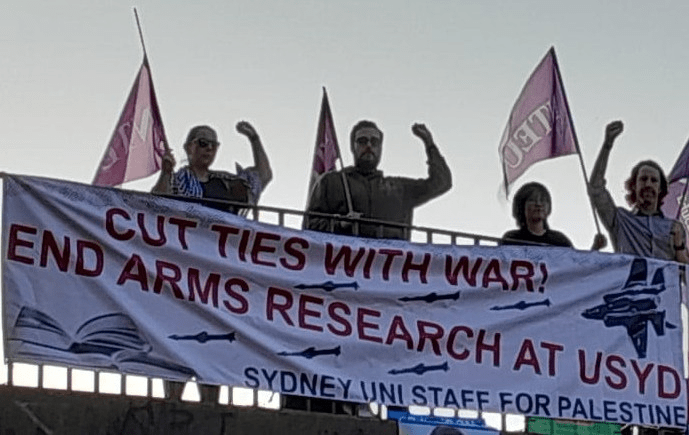
Sign the Open letter against USyd’s participation in Land Forces and the global weapons trade

Markela Panegyres

Sign the Open letter against USyd’s participation in Land Forces and the global weapons trade

Today, the University of Sydney shamefully hosted a session at the Land Forces 2024 Expo—Australia’s largest international weapons sales and military technology fair.

It is unconscionable that while Israel wages a genocidal war on Gaza and Palestinians, our own institution is involved with the global arms trade.

As university staff, we should reject our university’s involvement in and Forces and the global weapons trade. Universities should be for the public good, not for profiteering from war or contributing to weapons research.

Please sign and share this open letter against USyd’s participation in Land Forces

Click here to view the original response on Yammer and respond there

Student caps shouldn’t mean fewer jobs or hiring freezes!

Sophie Cotton

It now looks like USYD will have 890 fewer students next year.

What if management didn’t sack anyone? What would that look like for us?

While student numbers have shot up in recent years, staff numbers have not.

The education department’s data only go up to 2022, but we can model what 890 fewer students would mean for workload intensification and teaching hours per student.

The result in the attached graph (dashed line) is absolutely negligible compared to the massive teaching workload intensification over the last 20 years.

Looking at USYD’s teaching workload increases compared to student EFTSL I found that since 2001 “student load has increased by 96%, while equivalent teaching hours are up just 21%. Figure 1 shows that the amount of students has increased from 31 to 50 students per teaching hour in the latest available figures.”

The sector has faced “crisis” after “crisis”, but while Management has cried poor, it is staff who’ve had to take up more and more workload.

All the pauses on new hires, contract non-renewals, casual staff pauses, are management’s attempt to push this number higher and higher in the coming years.

Join the NTEU and help us stop that happening.

We absolutely need to fight the government’s racist student caps, which we are trying to do as a union, but we cannot buy the line that cutting staffing is the answer.

Respond and react to the original post on Yammer.

2024 Election Statement

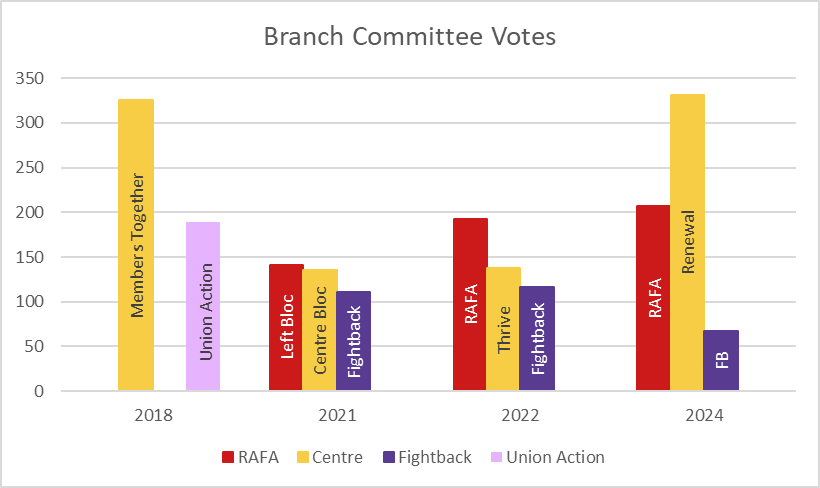
After a period of left dominance, the recent University of Sydney NTEU elections have seen a swing back to the right. RAFA has narrowly lost the majority of executive positions, but will retain a strong presence on the incoming branch committee, and has secured three delegates to National Council. With the position of Indigenous BC member remaining to be filled, the incoming committee of 14 will comprise 6 RAFA members, 6 from the Renewal ticket, 1 from Fightback, and one independent. 

In large part these results reflect the divisions in the branch on which the last Enterprise Bargaining campaign concluded. RAFA’s commitment to grassroots democracy and advocacy of a strong mobilising base were key to resisting the worst attacks and making some important gains during the 2022-3 bargaining campaign. But the key penultimate meeting voted against RAFA’s call for further strike action by a margin of 374 votes to 290, with members of what became the centre/right Renewal faction arguing that the branch had become too militant.

Renewal ran a ticket weighted toward senior members of staff, with strong representation from the Business School. A Renewal incumbent will retain Vice-President (Professional), and a Renewal candidate will also resume the position of Branch Secretary from which they resigned in 2023. In the race for president, Renewal ally Peter Chen ran as an independent and narrowly outpolled RAFA’s David Brophy by 296 votes to 290. 

Bucking this general trend, RAFA’s Nick Riemer won Vice-President (Academic), testament to his record as branch president. 

Fightback has been reduced from four members on the branch committee to one, who was elected under quota. We see this as a rejection of Fightback’s divisive and disruptive strategy of self-differentiation. Sadly, Fightback’s antics have tainted the activist left of the branch more generally, allowing Renewal to paint RAFA as equally sectarian and self-interested. 

Participation in these elections was up by approximately 100 from last time, a positive sign of increased engagement with branch affairs. In contrast to this general trend, though, the participation of casuals declined, a sign of demoralisation in this section of the membership. Many casuals feel let down by the NTEU Division and National Office, who curtailed the wage theft fight in FASS, and have persistently withheld campaign resources. Casuals organising at the University of Sydney needs revitalising, and the election of RAFA’s Markela Panegyres as casuals’ representative to the BC positions us well to undertake this task.

On the basis of these results we remain confident that RAFA’s vision of a militant, campaigning branch retains the support of a significant section of the membership, likely to include those who participated in striking and picketing through our lengthy 2022-23 strike campaign, and those active in Palestine solidarity work. In numerical terms, RAFA’s branch committee vote of 207 is a slight increase on the left vote in the past four elections. 290 voted for David Brophy, the continuity candidate from Nick Riemer. Clearly, a strong minority of USyd staff are willing to register support for a militant and democratic approach to bargaining, and for unapologetically leftist positions on social and international issues. 

There is no room for complacency though: a vote of 290 (for president) still constitutes only half the voting membership of the branch and one seventh of its total membership. There is much work to be done to overcome the model of passive unionism that prevails throughout the NTEU, including at the Sydney University branch. 

In this respect, we cannot but be disappointed by this election result. While offering some positive proposals for recruitment and delegate organising, the Renewal ticket also fed on suspicions of branch activism, appealing to less engaged members with calls for a “decent” branch. We hope this stance is not reflected in their practice in the coming term, which will require a serious mobilisation of members in preparation for enterprise bargaining in 2026. 

We in RAFA are committed to a comradely branch culture, and will seek every opportunity to collaborate with the rest of the newly elected BC in fostering collective action across political differences. Naturally we also look forward to continuing our work at the local workplace level and in campaign bodies, and to extending and deepening the culture of union activism at the University of Sydney.

If you support our vision for the NTEU branch, we invite you to join our meetings and campaign alongside us.

RAFA meets fortnightly on Fridays at 12. Get in touch if you’d like to come along. 

Read the full rundown of the results here.

Firearm in Fisher Library:

Plainclothed police officer threatens student and staff

Jason Todd

In a truly shocking incident last week, a staff member and a student in the Fisher Library were threatened with a holstered firearm by an unidentified man, who was later determined to be a plainclothed police officer. Protective Services have declined to take any further action, and appear to consider such reckless disregard for staff and student safety by the police to be acceptable.

The NTEU has written to management demanding serious action on this matter. It is utterly unacceptable that NSW Police feel entitled to freely waltz in armed and unidentified and use this campus as their personal offices, and to casually threaten staff and students in this manner.

The Vice-Chancellor purports to consider personal safety on campus such a priority that it requires crackdowns on fundamental freedom of speech, and restrictions on such dangerous items as posters and megaphones, and yet for almost a week we have heard crickets after an unidentified man threatened staff with a gun in their workplace.

The University has previously raised complaints when police have acted appallingly on campus, will the University act here?


Last Monday, a library staff member was showing a student the directions to a study room that they had booked, and when the staff member tapped on the glass of the room to get the attention of the two occupants and request that they vacate for the student with the booking, the plainclothed man inside stood up, turned towards the staff member and pulled back his jacket to reveal a holstered gun.

The visibly and audibly shaken staff member and student understandably decided that a room booking was not worth being threatened by an unknown man with a gun.

When University Security later came to question the armed man, who had at no stage identified himself as police, his ID was now on the table and he indicated that he was there interviewing a student. He stated that it would have been an inconvenience to get his ID out of his bag earlier, so he decided to flash a gun at a staff member instead, stating “it may not be common in your world, but in my world a gun isn’t that unusual”. Apparently study rooms at a University library should be considered part of “his world” where a firearm is a totally commonplace item to carry as a form of identification.

In response to the staff member’s very justified ongoing concerns, the Protective Services team responded that while the police officer’s conduct “may not have met expectations”, the police officer apologising apparently should have been the end of the matter, that they had no obligation or intention to raise the matter with NSW Police, and that the library was open for students or staff to meet with police officers for personal matters. They suggested that the staff member could raise a complaint with the police himself if he liked. Protective Services even noted that “On a positive note, it’s encouraging to see that the student views the library as a safe place for this conversation to occur”, with a shocking disregard for whether the library is now a safe space for the staff and student who had a gun flashed at them.

An unidentified man with a gun walked into the library in the heart of main campus totally unannounced, then flashed his gun threateningly at staff and a student, and this is seriously the response?

This is not even the first time that this has occurred. Staff may recall that during the NTEU strikes last year, undercover police disguised as students also flashed guns at staff on the picket lines. Unsurprisingly, the University took no action then either. NSW Police also have a sorry history of inappropriate action on campus (sometimes with the active collusion of the University), and of course of extreme violence against staff and students taking part in off-campus protest action.

Having a gun suddenly flashed at you by an unidentified person in the course of doing your job on campus is a deeply unsettling experience that I think would seriously affect any of us, and particularly in light of the recent stabbing on campus. But even more than that, fatal police shootings are at an all-time high, and the NSW Police force have shown themselves to be exceptionally cavalier with the use of firearms. I share the links below (content warning: descriptions of violence and self-harm) to illustrate that it is not an exaggeration to say that armed police on campus pose a legitimate risk of deadly violence towards staff or students. A hooligan with a badge so drunk on his own power that he thinks it’s okay to flash a gun at library staff to “identify” himself is absolutely a safety risk to everyone on campus, much more so than any students in tents ever were.

Links:

USYD Real Wages Quarterly Update

Sophie Cotton

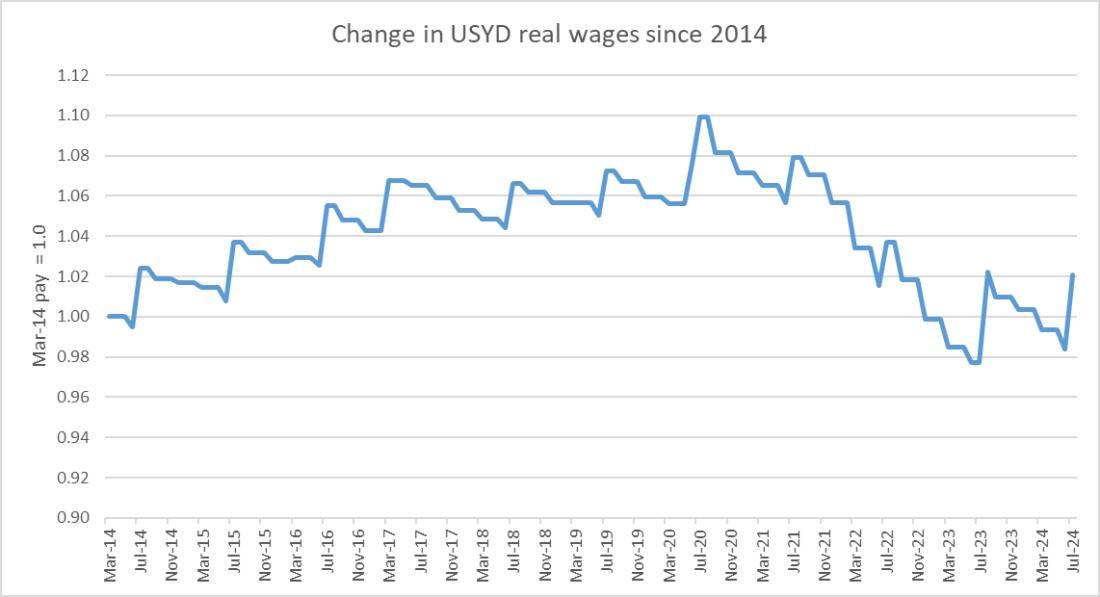
Our wages are still not keeping up with inflation. Our latest pay rise hasn’t met inflation over the last year with the RBA June update putting inflation at 3.8% over the past year, while we received a 3.75% pay rise last month.

Sydney rents have increase 8.1% over the last year. Rents and medical expenses are both up 2% over the last quarter alone!

Since our last pay rise in August, staff wages have gone backwards in real terms.

It would have been much worse without the NTEU campaign.

Management’s original offer was for just 3.25%.

It was union members who got it to 3.25% in the first place and who took further strike action to move it to 3.75%.

If you’re not already a member of the NTEU, you should join now. It was union members who sacrificed for this win, while all members benefited from our action.

And if any of us want to see our wages moving forwards not backwards, we need more membership and more activity now in preparation for our 2026 bargaining.

A response to rival tickets in the branch elections

The current NTEU elections are the most contested ever in our branch. This is testament to our democratic culture, and something that we should all be proud of. At RAFA, we want to focus on our record and our positive vision for the union. But we need to respond to a number of claims made by competing tickets which we think are wrong, and also quite seriously out of touch with what’s actually happening in the branch.

Strategy in EA campaigns. Both of the other tickets make much of the role of strikes in industrial strategy. NTEU Fightback have structured their whole campaign around the need for longer strikes. Essentially, we agree: we do need longer strikes in EA periods, but that will only be possible if we have the collective strength and stamina to pull them off. This is a point Fightback have consistently ignored. Instead of patient building work, outreach, recruitment and political discussion with colleagues to convince wider layers of the need for participation in branch activism, Fightback prefer to emphasise what they see as the errors of the previous campaign and the inadequacies of the existing clauses – even though most members voted for these!

Renewal also want to talk about strikes – to emphasise that they’re only one tactic among others. We don’t think this debate is the most important one to be having in our current situation, given that protected industrial action of any kind won’t be possible again until 2026. Candidates for Branch Committee need a vision for the branch now, given the options that are open to us at the moment, and a set of proposals for activism that isn’t just about what the best tactic will be in unknown concrete circumstances in two years’ time. We remain committed to strikes as our most powerful industrial tool, but we’ve moved on since the EA campaign, and we’re busy with a whole variety of campaigns to defend members’ interests in the branch. An active branch membership, practiced in implementing and enforcing our current agreement will ensure the branch is best placed to pursue improved conditions in future bargaining rounds. 

Branch priorities. Renewal say they want to concentrate on three areas of union work: workloads and job security, change management, and workplace representation (see below). We agree with all three, and we’ve been working successfully on all of them, as detailed elsewhere on this site. But we’re puzzled as to why Renewal members have waited until the election campaign to raise these priorities. Two Renewal candidates, as well as their presidential pick, Peter Chen, are already on Branch Committee; one candidate is the current Vice-President for professional staff. If they have ideas for what the branch should be doing, they have had any number of opportunities to present them – whether at branch meetings, through Branch Committee, or through one-on-one approaches to other elected branch office-holders, including us. At no point since the end of the EA campaign have Renewal candidates made concrete proposals for a strategy on any of these fronts. Quite the contrary: they have been silent, and, we can only assume, on board with the branch’s current activities in these domains, all of which have been discussed and approved at Branch Committee meetings.

What are Fightback’s  priorities? They say they want better clauses, and a more “watertight” EA. However, the only way we will win better clauses in our next EA, and, more importantly, enforce them, is to build an active, confident and comradely branch that works with members to build opposition to management’s constant restructures, wage theft, the so-called ‘Academic Excellence Framework’, the draconian Campus Access Policy, and other hostile initiatives. RAFA members also want better clauses, higher pay, and a better university for all, but we see the need to orient to the entire membership in order to achieve this. 

Workplace representatives. Renewal say they will prioritise creating a workplace delegates network. But there are central NTEU plans underway to roll out a formal delegate structure throughout the union – something we have not had before, and something which requires changes to the rules and structure of the NTEU. This is currently being pursued at the NSW Division level. As a result, creation of formal delegates simply isn’t something that we have power over in the branch. At RAFA, we think that, while we’re waiting for a proper delegate structure to be formally established, the route to greater workplace representation lies in encouraging involvement and activism in local areas, thereby identifying the organic workplace leaders who can play a de facto role as delegates. This is exactly what the branch is doing, for instance in the context of the change plans in the Library and ICT, or in organising around academic workload.

Branch inclusiveness and involvement. Like Fightback and us, Renewal is a self-conscious, open faction in the branch. Yet they disparagingly refer to us and Fightback as ‘factionalists’, and accuse us of treating the branch as our ‘plaything’. To be honest, we find this quite unfair: as we’ve said, Renewal members are office-holders on Branch Committee and Branch Executive, and therefore in positions of direct influence over branch activities. All of the major initiatives the branch has taken since the EA have been consensus or near-consensus decisions of the very Branch Committee to which their members belong. RAFA members consistently work with everyone in the branch, and we consistently seek out consensus positions. Even though we have a majority on Branch Committee, we have never needed to use it in the post-EA period.

Renewal also want to suggest that we’re only interested in catering to the interests of a minority of branch members. Tell that to the members who we’re supporting through change plans, the ones we’re campaigning for a better deal over campus parking for, or the ones we’re defending against hostile managers! They also don’t even have casual members on their ticket – how can you unify the branch without elevating casual voices?! The politics that RAFA has been arguing for have consistently led to the largest branch meetings we have ever had, both during the EA campaign and after it, in the form of the Palestine vote. At these meetings, we have taken consistent steps to encourage more comradely interactions, and throughout 2023 we held regular branch drinks to boost members’ sense of the branch as a community. We don’t recall Renewal candidates often (or in some cases ever) attending these drinks. We’d also note that they’re not regular attendees at other branch events, either – a very strange position for people who are promising to increase involvement in the union.

Finally, we have to note that the candidate for Branch Secretary resigned from that role suddenly and very publicly last year over Palestine, without any attempt to discuss her concerns with us first, and sending an inflammatory and factually inaccurate email to the entire branch, which immediately found its way into the Sydney Morning Herald, where it can provide ammunition to conservative voices eager to discredit unionism in general and the NTEU in particular. We don’t think this kind of behaviour was in the best interests of anyone: in fact, it was an example of exactly the kind of divisiveness that Renewal claim to oppose.
Endorsement: Benjamin Lasker

FASS curriculum

We need a union that works with its membership, and union organisers whose rhetoric and action meet members where they are, speaks to their concerns and is committed to building the union up, not tearing it down. I am voting for Rank and File Action because they embody these principles in their organising. I have seen how Rank and File Action works with members to get real change, both at the picket lines and in their workplaces, and I believe that they are the best equipped to prepare us for our next fight in 2026.

Endorsement: Tatjana Seizova-Cajic

Faculty of Medicine and Health

I wholeheartedly support union members who are on the RAFA ticket. They have demonstrated the highest level of commitment by any standard and possess admirable clarity of vision. They navigate our complex environment with integrity and fight for the right causes, from our rights at work and the responsible use of University and UniSuper resources to global justice.