It now looks like USYD will have 890 fewer students next year.
What if management didn’t sack anyone? What would that look like for us?
While student numbers have shot up in recent years, staff numbers have not.
The education department’s data only go up to 2022, but we can model what 890 fewer students would mean for workload intensification and teaching hours per student.
The result in the attached graph (dashed line) is absolutely negligible compared to the massive teaching workload intensification over the last 20 years.
Looking at USYD’s teaching workload increases compared to student EFTSL I found that since 2001 “student load has increased by 96%, while equivalent teaching hours are up just 21%. Figure 1 shows that the amount of students has increased from 31 to 50 students per teaching hour in the latest available figures.”
The sector has faced “crisis” after “crisis”, but while Management has cried poor, it is staff who’ve had to take up more and more workload.
All the pauses on new hires, contract non-renewals, casual staff pauses, are management’s attempt to push this number higher and higher in the coming years.
We absolutely need to fight the government’s racist student caps, which we are trying to do as a union, but we cannot buy the line that cutting staffing is the answer.
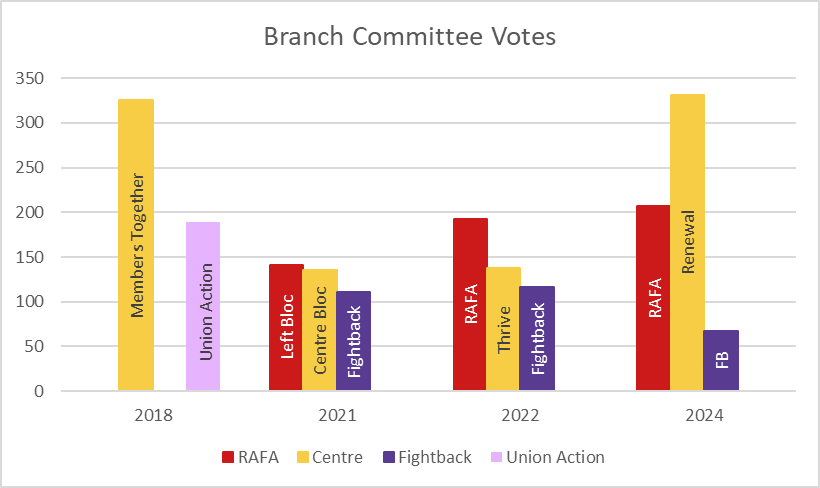
After a period of left dominance, the recent University of Sydney NTEU elections have seen a swing back to the right. RAFA has narrowly lost the majority of executive positions, but will retain a strong presence on the incoming branch committee, and has secured three delegates to National Council. With the position of Indigenous BC member remaining to be filled, the incoming committee of 14 will comprise 6 RAFA members, 6 from the Renewal ticket, 1 from Fightback, and one independent.
In large part these results reflect the divisions in the branch on which the last Enterprise Bargaining campaign concluded. RAFA’s commitment to grassroots democracy and advocacy of a strong mobilising base were key to resisting the worst attacks and making some important gains during the 2022-3 bargaining campaign. But the key penultimate meeting voted against RAFA’s call for further strike action by a margin of 374 votes to 290, with members of what became the centre/right Renewal faction arguing that the branch had become too militant.
Renewal ran a ticket weighted toward senior members of staff, with strong representation from the Business School. A Renewal incumbent will retain Vice-President (Professional), and a Renewal candidate will also resume the position of Branch Secretary from which they resigned in 2023. In the race for president, Renewal ally Peter Chen ran as an independent and narrowly outpolled RAFA’s David Brophy by 296 votes to 290.
Bucking this general trend, RAFA’s Nick Riemer won Vice-President (Academic), testament to his record as branch president.
Fightback has been reduced from four members on the branch committee to one, who was elected under quota. We see this as a rejection of Fightback’s divisive and disruptive strategy of self-differentiation. Sadly, Fightback’s antics have tainted the activist left of the branch more generally, allowing Renewal to paint RAFA as equally sectarian and self-interested.
Participation in these elections was up by approximately 100 from last time, a positive sign of increased engagement with branch affairs. In contrast to this general trend, though, the participation of casuals declined, a sign of demoralisation in this section of the membership. Many casuals feel let down by the NTEU Division and National Office, who curtailed the wage theft fight in FASS, and have persistently withheld campaign resources. Casuals organising at the University of Sydney needs revitalising, and the election of RAFA’s Markela Panegyres as casuals’ representative to the BC positions us well to undertake this task.
On the basis of these results we remain confident that RAFA’s vision of a militant, campaigning branch retains the support of a significant section of the membership, likely to include those who participated in striking and picketing through our lengthy 2022-23 strike campaign, and those active in Palestine solidarity work. In numerical terms, RAFA’s branch committee vote of 207 is a slight increase on the left vote in the past four elections. 290 voted for David Brophy, the continuity candidate from Nick Riemer. Clearly, a strong minority of USyd staff are willing to register support for a militant and democratic approach to bargaining, and for unapologetically leftist positions on social and international issues.
There is no room for complacency though: a vote of 290 (for president) still constitutes only half the voting membership of the branch and one seventh of its total membership. There is much work to be done to overcome the model of passive unionism that prevails throughout the NTEU, including at the Sydney University branch.
In this respect, we cannot but be disappointed by this election result. While offering some positive proposals for recruitment and delegate organising, the Renewal ticket also fed on suspicions of branch activism, appealing to less engaged members with calls for a “decent” branch. We hope this stance is not reflected in their practice in the coming term, which will require a serious mobilisation of members in preparation for enterprise bargaining in 2026.
We in RAFA are committed to a comradely branch culture, and will seek every opportunity to collaborate with the rest of the newly elected BC in fostering collective action across political differences. Naturally we also look forward to continuing our work at the local workplace level and in campaign bodies, and to extending and deepening the culture of union activism at the University of Sydney.
If you support our vision for the NTEU branch, we invite you to join our meetings and campaign alongside us.
RAFA meets fortnightly on Fridays at 12. Get in touch if you’d like to come along.

 Rank-And-File Action USYD