In ‘Lessons from the NTEU Sydney University industrial campaign‘, Jerome Small has delivered Socialist Alternative’s damning verdict on the USyd Enterprise Agreement (EA) campaign. Writing from outside the higher education sector and apparently without any attempt to verify important facts, his article is remote from the realities of the USyd campaign, and can only be intended for an audience similarly remote from those realities. Reading Small’s piece, one might easily get the impression that Rank and File Action (RAFA) – whom he polemicises against at length – have been leading the charge to sell an inadequate EA offer to NTEU members. The truth is entirely otherwise. Anyone with the slightest acquaintance with the campaign would know that every single one of our branch’s recent mass meetings have seen RAFA members move, and argue strongly for, motions to reject the current management offer and continue our escalating strike campaign – as we have done consistently from the start. In the same vein as Small’s article, statements from the Socialist Alternative-backed Fightback faction have similarly sought to airbrush this inconvenient truth from the history of the campaign.
Small’s article, like much of Fightback’s commentary, is clearly more interested in crafting a narrative than engaging with the facts. What is that narrative? Simply put, that Socialist Alternative/Fightback represent the only true radicals inside the NTEU, while the rest of the Left are enemies to be denounced – more dangerous to the cause, even, than the Right of the branch. This classically sectarian attitude was on display, for example, in their decision to preference members of the conservative Thrive faction over RAFA members for positions in the 2022 Branch Committee elections. To give him credit, Small is honest enough now to acknowledge Thrive to be a ‘more conservative’ faction than RAFA. At the time, some members of Socialist Alternative claimed otherwise, so as to justify this unprincipled decision.
Detecting the symptoms of class treachery wherever they look, Fightback members have thus prioritised differentiating themselves from the rest of the Left throughout the USyd campaign. Many USyd branch members experienced this in the form of regular disruptive interventions into meetings to change the agenda and maximise speaking time for their key members – interventions that were not well received by the mass of members, and which turned some away from meetings entirely. At Branch Committee level, Fightback often adopted a ‘my way or the highway’ stance, even refusing to vote for RAFA-sponsored strike motions when their own proposals failed to win majority support, thereby putting petty factional considerations ahead of their commitment to industrial action. They made a habit of levelling misguided accusations against other members of the branch leadership: criticising the president and bargaining team for not issuing bargaining updates, for example, seemingly unaware that members had consistently been emailed detailed updates after every bargaining session. Indeed, contrary to Small’s claims that members have been kept in the dark about developments at the bargaining table, the branch’s email updates and regular drop-in sessions have kept members more fully apprised of bargaining progress in this EA round than in any other. Ironically, at other moments of the campaign, Fightback members criticised the branch leadership for spending too much time, not too little, on updating members.
Most outrageously, Small’s claim that RAFA has been ‘organising against’ escalation for the last year is of a level of outright fantasy that should permanently discredit him as a serious commentator on union affairs. The simple facts of the matter are that RAFA devised and argued for the program of escalation in Semester 1 of this year, which doubled the number of scheduled strike days compared to 2022; and that throughout the campaign, RAFA has without any doubt been by far the most active group of members in the branch, taking the lead in all campaign activities (leafleting, stalls, postering, member phone calls), producing numerous bulletins arguing for our strategy, and supplying the majority of the picket captains on strike days. Outside noisy and self-promoting interventions at members’ meetings, Fightback members’ commitment to the hard slog of campaign work has never reached anything like the level of RAFA’s.
At times, Fightback’s attacks on us have descended into outright fabrications. After one strike meeting, for example, Fightback members circulated a false claim on social media that two RAFA members had voted against the very strike motion we argued for strongly. In his article Small seems equally happy to misrepresent our views, claiming that Branch president Nick Riemer ‘celebrated a terrible deal at Western Sydney University as a win.’ Riemer did nothing of the sort, simply noting that the terms of the WSU decasualisation package specifically should ‘reset’ negotiations in other branches, and arguing that ‘USyd can easily afford something even better.’ This is the second time that Red Flag has published demonstrably false claims about Riemer’s position.
At various times in the campaign, Fightback’s rhetoric has been nothing short of unhinged. Not content with accusing RAFA of allying with branch conservatives and the National Office, their most recent screed lumps us in with the USyd Provost too, pointing to the existence of an ‘unholy alliance of Jagose, RAFA and Thrive’.
The idea that people like Nick Riemer or David Brophy are closet allies of Annamarie Jagose will be laughable to anyone who works at the University of Sydney, but such is the bubble of irreality that Fightback occupies.
However, there are more serious strategic questions involved in the USyd campaign than Fightback’s petty sniping would suggest.
While RAFA and Fightback have both argued strongly for strikes as the core of our industrial campaign, we in RAFA have recognised the challenge of maximising member participation in industrial action. The question of the capacity of the branch is not one that can be ignored, and must weigh in considerations of what proposals for action to put forward and when.
Fightback, by contrast, have been dismissive of any debate surrounding the waxing and waning of member participation – even arguing in one BC meeting that low attendance at picket lines was a positive sign (members were, according to them, so confident the strike would be a success that they didn’t feel any need to come in)! The result has often been proposals that in our view far exceeded the capacities of the branch, and which were therefore less likely to win majority backing. These assessments were entirely vindicated. Most recently, in flagrant contradiction to the spirit of the ‘open-ended strikes’ strategy they espouse in the abstract, a proposal for a five-day strike was withdrawn by Fightback itself at the last minute, reflective of the unserious and often chaotic nature of Fightback strategy. Promises of easy victories have been par for the course: witness Alma Torlakovic’s claim at the last members’ meeting that fighting a non-union ballot would see us ‘double our membership’.
Obviously we’d all like to see bigger, more impactful strikes than we currently do in the NTEU. One of Small’s key ‘lessons’ from USyd seems to be that the branch would have been better served by going out for nine days straight. Tactical suggestions and constructive criticism are welcome – as long as they are serious, and not made in a vacuum of any consideration of political realities. The quality of strikes – the extent to which they are actually observed, and pickets properly maintained – is no less important than their quantity. Regardless of the desirability of long strikes in the abstract, no serious observer of the USyd branch could believe that a nine-day strike was feasible at any point in the campaign. USyd members had ample opportunities during votes at members’ meetings to endorse Fightback’s vision for longer-lasting industrial action had they been prepared to. They consistently declined to do so.
Finally, we have the question of the outcome of the campaign. Talking up industrial gains is not the role of union radicals, and not one that we have taken on. We agree with many of the criticisms that Small levels against the current package. That’s why we opposed winding the campaign up at the 700-member strong meeting, and spoke strongly against the inadequate pay offer and the completely unacceptable expansion of teaching-heavy ‘education-focussed roles’, to name just two areas where we were explicit that the deal was unsatisfactory.
At the most recent meeting it was National Office and Thrive who spruiked wins; our interventions highlighted the shortcomings of the package. Far from being in league with these national officials, RAFA has consistently warned against the possibility of the union bureaucracy leaning on the branch to shut down its campaign: our bulletin has carried long articles on precisely this point.
But talking down gains and dismissing the efforts of members is not the role of radicals either. Socialist Alternative’s claim that ‘For workers at Sydney Uni, working life will get worse under this EA, not better’ is a self-serving simplification. As we have noted, the deal contains major shortcomings. But the preservation of research rights for ongoing academics; the decasualisation measure of 330 additional ongoing jobs, even partly education-focused ones; the undertaking to commit, in the EA, to instituting sick pay for casuals as university policy; the extra 6 months’ redeployment period for professional staff whose positions are made redundant; the commitment to enforceable measures towards Indigenous employment parity – all these are significant achievements, which members only secured through their willingness to take industrial action, and which should not be opportunistically minimised.
Small’s dismissal of wins stretches reality to meet his predetermined conclusion. His claim that the win of five days sick leave for casual staff is an ‘overstatement or misleading’ is peculiar. The union won a clause in the agreement that management will implement the policy of five days casual sick leave within twelve months. This wasn’t our first preference – we wanted sick leave directly in the agreement – but to dismiss the win entirely as ‘unlikely to be enforceable’ strikes us as inaccurate and highly doctrinaire. The conclusion on wage theft is similar: whereas the previous agreement provided that management ‘accepts the principle’ that casual staff ‘should’ be able to complete the work in the given time, the new agreement provides that casual staff ‘will be paid for all work they are required to perform’. Small’s dubious reading of this change is that it is a diminution of conditions, rather than a strengthening! The utopian demand that casuals should be automatically paid for every hour they bill the university was not even in our original log of claims, but is now being used retrospectively as a measuring stick against which to denigrate the win!
By dismissing any progress made in the course of the USyd campaign, the message Socialist Alternative is sending to the wider NTEU is that nine days of strike action have achieved nothing. In the current political climate, with serious strike action a rarity in the NTEU, it has to be asked who in the union this message is more likely to provide a boost to: leftists trying to convince others of the value of strikes, or conservatives who argue against any strikes at all?
Our campaign of nine days of strikes has seen off some, but not all of the attacks we were facing. It has won some, but not all, of the claims that we put forward in our log. Recognising these facts need not involve the exaggeration or dissimulation that Small attributes to us.
There are many ways that radicals can usefully contribute to union campaigns. Dishonest, uncomradely polemics aimed at sectarian differentiation and the relentless promotion of one’s own organisation to the detriment of the wider Left is not one of them. We are very keen to play our part in minimising the divisions on the Left in the branch. RAFA has always had a vision of a broad left caucus which could encompass and debate strategic differences, and we remain convinced of that vision. Some factional divides between left-wing groups on principled grounds are inevitable, but when they arise for spurious and sectarian reasons they are unnecessary and counter-productive. We think that many members who have supported Fightback at different moments of the campaign would not subscribe to Socialist Alternative’s analysis, and would share our commitment to building collective union struggle without recourse to the forms of toxic debate we have illustrated above. The threat is management. The time we have spent here defending ourselves from unwarranted critique should have been able to be spent on union work defending staff from management. We would like nothing more than to work together with Fightback members for the collective good of all members. It is up to them to show a similar willingness to collaborate in a comradely way with us. Our door is always open.
Stay in touch with RAFA via our mailing list and social media here
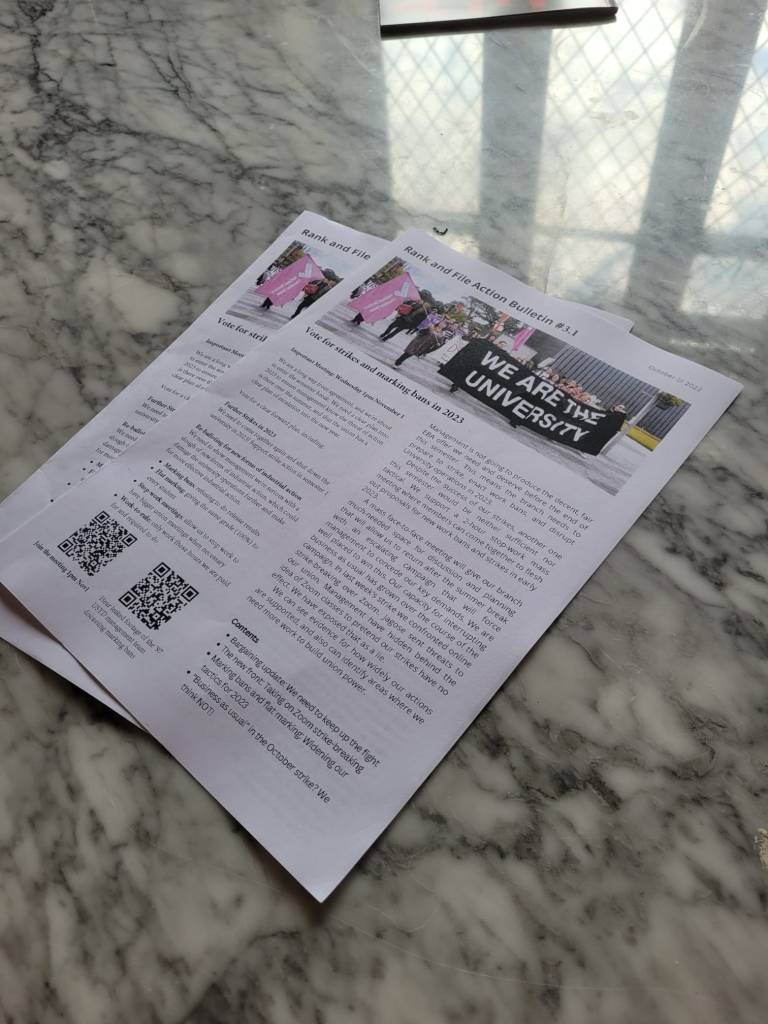
Bulletins
See our latest bulletins, reporting on the latest developments and how we can build a winning campaign.
They’re available in print at union meetings or digitally.

Join the RAFA Mailing List
Stay in touch with RAFA via our mailing list

Campaigning & Strike Resources
See the campaigning resources from the campaign.




 Rank-And-File Action USYD