Bargaining meeting 33

Adapted from member email 21/2/23

At bargaining today, management blindsided our bargaining team by making a lower wage offer than any union-agreed pay-rise in the higher education sector – 3.3 per cent per year from the expiry of the last agreement to the end of the one we are negotiating now. Management is trying to ignore that we are coming up to two years since our last Agreement nominally expired – a period in which inflation ran at well over ten per cent. On paper, they are offering a 14.6 per cent flat pay-rise from July 2023 to July 2026. But don’t be fooled by this figure: in real terms, their offer amounts to a 3.3 per cent pay-rise over the five years to 2026 (16.7 per cent in toto). This is a lower figure than the average annual increase (expiry to expiry) in other union-endorsed agreements, all of which are less rich than Sydney Uni, and some of which even posted a deficit, for instance at WSU, ACU, UTAS or UTS. How is a pay-rise less than these universities, who are all in worse financial positions, possible? This is a low-ball offer which is completely unacceptable and an insult to staff.
 
They are also maintaining their attack on 40:40:20, and still seeking the right to force academics to increase their teaching by one quarter, to a 50% allocation.

Bargaining Meeting 37

Adapted from all member email sent 29/3/23

Two main things happened in yesterday’s bargaining session: 

  • Management were not prepared to make any compromises on the number of Education-Focussed (EF) roles, though they did make some movement on protecting the workloads for EF staff at Levels A, B and C. While this movement provided some protections, no one in the Bargaining Team believes that management’s current position on this issue, described below, is adequate.
     
  • Management increased their pay offer slightly, adding 1.5% in toto over the life of the agreement and shortening the Agreement by a month. This increase will now just allow them to claim that they are offering the highest percentage pay rise that we’ve seen so far in the current round of enterprise bargaining nationally.

You can read more on each issue below. The terms of the professional staff package remain unchanged. On the Indigenous employment target, we’re yet to receive a management response.

Bargaining update: Education-focussed roles

As we have reported previously, the Bargaining Team remains opposed to both the 25% cap on EFRs as a proportion of the non-casual teaching workforce that management want, and to the 70% maximum teaching allocation for these roles that they are insisting on. These are both too high. We also feel that the new workload review mechanisms which management are prepared to establish, while welcome, will not be as reliable a form of protection as workload maxima written into the agreement.

In the interest of exploring possible solutions, we asked management whether they would consider reducing the teaching allocation for more vulnerable junior staff, i.e. EFRs at levels A-C. After some back-and-forth, they said they would be willing to provide a 10 percentage point reduction in the teaching load for 2 years (this would see the standard EFR allocation as 70/20/10 – but the teaching workload required would be reduced to that of a 60% staff membe for the first two years, and they would not be required to do any extra research of service), with a possible extension via the AP&D process to 3 years, for all level A and B EFRs, and also for those level Cs who have not previously held a continuing or fixed-term teaching position of at least two years at a university. The bargaining team did not feel this went far enough to meet our concerns and resolve the clause, and we told management so. They indicated that this was as far as they were willing to go.
Bargaining update: Pay

Management are maintaining the flat $2000 payment when the agreement is signed, but they have increased the last 3 annual pay rises of the agreement (those to be paid in 2024-2026) by half a percentage point, giving us 18.2% for the life of the agreement, or an expiry-to-expiry annual pay rise of 3.7% flat and 3.98% compounded. This just, and only just, will allow them to claim that they are offering the highest percentage pay rise that we’ve seen so far in the current round of enterprise bargaining. This is obviously well below our claim of 5% or CPI + 1.5% per annum. On current CPI predictions we are still facing a cut in real wages of between 4% and 5% over the life of the agreement.

 20232024202520262022-2026Annual expiry to expiry
Old offer4.60%3.25%3.25%3.50%16.70%3.34%
New offer4.60%3.75%3.75%4.00%18.20%3.70%

No Pay—No Deal: Fight on to Week 6 Strikes

RAFA Bulletin #7: Editorial

Management say that strikes don’t do anything, but if this campaign has proven anything, it’s that this is simply not true.

After months campaigning and strikes, we have extracted three hard-won concessions:

  • Pay for all hours work for casual staff;
  • 5 days per year of sick pay for casual staff;
  • Extended notice period for professional staff redeployment.

But the kicker is a tricky poison offer on the 40:40:20. Management have given us an all-or-nothing ultimatum. They’ll give us 40:40:20, but only if we sign off on an academic package with a 25% EF cap! This amounts to tripling the Education Focussed workforce from 220 to 650, with only some limited protections (a right to convert after 5 years, and some workload protections). The massive expansion of education focussed roles will entrench a two-tiered system that will railroad opportunities for early career researchers. 

The package also comes with:

  • 20% decasualisation (up from 13%);
  • 330 early-career continuing academic jobs, including 110 balanced positions;

And on top of that, until we agree, they say they won’t improve the 3.3% pay offer, or bundle in the package some of our other key demands like First Nations Employment Parity, no to CET job cuts and Internal Advertising Rights for professional staff. Even worse, they refuse to say what kind of ‘improvement’ they’re prepared to make on pay.

We cannot fall into this management trap. 

We have to say: 

  • no to the latest package without a pay offer; 
  • no to the unprotected expansion of EF staff; 
  • no to separating pay, First Nations rights & general staff rights from academic rights.

We want to bargain in good faith for a whole new agreement, with all cards on the table. 

No to the package; and go ahead with the week 6 strikes. Talk to your colleagues and make week 6 a resounding success!

Why not postpone the strikes?

We haven’t really won the 40:40:20 until it’s on terms we should accept. And moreover, if we call off the strike without the wins it was designed to obtain, we take the wind out of the campaign sails and set ourselves up for saying yes to whatever pay offer management comes to us with. We have made a lot of gains, on things like leave, workload regulation, flexible work and work from home rights, and others. But the only major new wins are on sick pay, wage theft & extended notice period. This is great progress, but it’s just not sufficient for postponing a strike, harming the building we’ve already done, and de-mobilising members. For now, we need to fight on.

Ignoring Half the Membership is No Way to Lead a Branch

A Response to Fightback from Rank and File Action

NTEU Fightback have issued a statement criticising members of the Sydney University NTEU Branch Committee, including members of RAFA, who sought to maintain branch unity and reach a compromise after Thursday’s extraordinary tied vote. Here we respond.

The mass meeting of March 23 put us in a position no one was prepared for: a vote of close to 600 members that ended up tied on the two substantive motions – one to defer the upcoming strikes, one to maintain them. Fightback’s statement avoids all mention of this crucial context.

The role of the Branch Committee is to implement the will of the membership, even when that will is split 50:50. That evening, BC thrashed out a compromise: 1) To defer the strike of Wednesday March 29 to the following week to allow time to consider developments in bargaining; 2) To maintain the strike on Friday March 31 (Census Day). This satisfies those who want more time for deliberation, and it maintains a plan for 48hrs of strikes should progress in bargaining be deemed insufficient.

RAFA’s position on strikes is obvious: we initiated, moved, and seconded the BC majority motion on Thursday. But for our industrial campaign to advance, we need to ensure that as many members as possible are committed to it. By slightly rearranging our strikes, we have secured the support of both sides of Thursday’s debate for ongoing industrial action.

Indeed, it was our hope that this solution would receive the unanimous support of Branch Committee members. Sadly, it did not. NTEU Fightback argued that our branch would be better served by simply maintaining a previous resolution to strike next Wednesday and Friday. After their motion was defeated, they either opposed or abstained from the motion endorsing the revised plan of strike action.

As a technical matter of procedure, it is true that Thursday’s vote did not overturn the existing resolution to strike on March 29 and 31. Politically, though, Fightback’s proposal struck us as entirely devoid of strategic sense, and likely to have produced a deep rift in the branch.

For the Branch Committee to have insisted that we were entitled to ignore the sentiment of a full half of the members’ meeting and maintain next Wednesday’s strike would have elicited strong resistance from many of those who sided with the minority motion. This would have seriously endangered not just that strike, but any future industrial action.

Do such considerations not occur to Fightback? Or is their desire to differentiate themselves from the rest of the branch so strong as to outweigh them? Sadly, this is not the first time that Fightback have seized on, or simply manufactured, opportunities to advertise themselves as the most militant, with seeming indifference to the strategic implications of their proposals.

In classic sectarian fashion, Fightback have listed RAFA members by name in their statement denouncing us. But the fact is, we’re happy to be associated with a decision that shows due regard for the will of the membership and the need for branch unity to take our industrial campaign forward. While Fightback expends disproportionate energy on point-scoring, we in RAFA will continue to listen to members, and seek as much unity as is possible, to carry on the militant fight we need for a fair EA.

More from RAFA
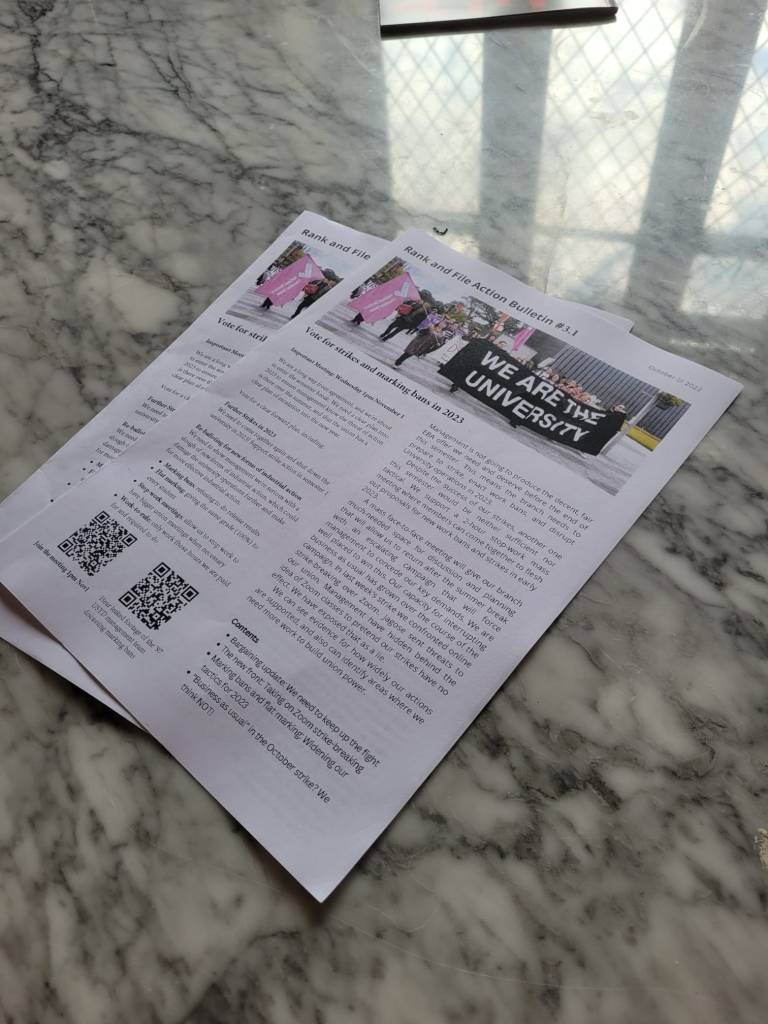
Bulletins

See our latest bulletins, reporting on the latest developments and how we can build a winning campaign.

They’re available in print at union meetings or digitally.

Campaigning & Strike Resources

Get involved with campaigning for the strikes, putting up posters, handing out leaflets, helping on stalls, or holding workplace meetings

Bargaining Updates

Read the latest updates from the bargaining table

NTEU Bargaining Update Meeting 36, 21/3/23

Bargaining update: a partial offer from management

Following last week’s strike action, yesterday’s bargaining session saw significant movement from management on a range of issues. This movement was presented in the form of two packages, one for professional staff and one for academics. Management’s position is that, if we accept these packages – and only if we do so – they will make an improved pay offer. However, they are refusing to tell us what this pay offer will be, and they have made it clear that if we reject the packages, their current – unacceptable – pay offer stands. They are, in other words, asking us to accept a suite of proposals in exchange for a salary offer they are not even prepared to disclose. I don’t think I need to comment on how unreasonable this is.

There can be no doubt that the packages management presented yesterday bring us significantly closer to agreement. As such, they are testament to the effectiveness of our campaign. Before outlining the positives in them, we need to be clear about the key areas where the packages do not yet embody an agreement that is acceptable:

  • All staff: management have not yet made an improved pay offer, though they say they will if we accept the packages, but they have not given any indication of when the offer will be made or what it will be.
  • Professional staff advertising: management are still refusing to maintain priority advertising of HEO 8 vacancies.
  • Academic staff: management are still refusing a 20% cap on Education-focussed roles. They are also rejecting our compromise, which is the 25% cap they seek with only a 60% teaching allocation, not the 70% allocation that EFRs currently have. Management’s proposal will usher in a major reconfiguration of the academic workforce, continue the decline of 40:40:20 staff in the workforce, and constitutes a fundamental attack on the teaching-research nexus, as we have described in this fact sheet.

The following paragraphs detail the main features of the professional and academic staff packages that management are putting forward. It’s important to repeat that if we accept these packages, management tell us that they have an ‘improved’ pay offer. Note that none of these lists is exhaustive. We will shortly be providing a more complete summary of the state of negotiation (about which members have been informed at great length in the regular bargaining updates). In the meantime, the most important features of management’s packages are as follows:

Professional staff (including casuals)

  • flexible work and work from home: major improvements (as described in previous updates);
  • workload regulation: a workload monitoring committee that establishes an entirely new mechanism for regulating professional staff overwork (offer described in previous updates);
  • job-security: rejection of our no-forced redundancies claim, but agreement to an extended redeployment period for HEO1-7, that would give professional staff whose positions are made redundant nine paid months employment during which management try to redeploy them into a suitable alternative position (new offer made yesterday as a result of NTEU pressure);
  • an eligibility list so that current professional staff who applied for a position and who were appointable without being the successful candidate, are offered the position if it becomes vacant again within 12 months (offer as previously described);
  • an increase in the Professional Staff Development fund;
  • Other provisions, described in the previous bargaining update.

Academic staff (including casuals)

  • an abandonment of the attack on 40:40:20 (new offer made yesterday);
  • a 25% cap on Education-focussed roles, with a 70% allocation for teaching, 20% for research and 10% for service. Management say that the 25% figure is a cap, not a target. But it would allow the employment of around 650 staff, including around 400 new, without the same research rights as other academics. The 70% teaching allocation will be subject to regulation and review through a three-person faculty panel with a union appointee and will not be automatically scaled up from the 40% allocation in 40:40:20 roles (offer as described previously). There will be transition rights for EF staff to move into 40:40:20 roles as long as they meet the research expectations of the EF role;
  • If EFs in a faculty or a university school (i.e. Law, ADP or the Conservatorium) were to exceed 25%, it would be subject to a report to the Joint Consultative Committee (new offer made yesterday);
  • A commitment to pay casuals for all hours they are required to work, with a review mechanism in cases where a casual believes that they are not being properly paid (offer as described previously);
  • decasualisation: a commitment to reduce the overuse of academic casuals by 20%;
  • decasualisation: 330 new jobs (30 more than previously offered), of which 220 will be EFs, and 110 40:40:20 positions. 25% of the EF roles will be prioritised for existing casuals and fixed-term staff. 50% of the 40:40:20 roles will be pathway roles for existing casuals;
  • the establishment of PhD fellows to give casuals greater job-security;
  • the establishment of professional practitioner positions.

In addition to the professional and academic packages, some reminders about what management are proposing (a) for all staff, (b) for First Nations staff specifically, and (c) for Centre for English Teaching Staff.

All staff (including casuals)

  • a greatly improved casual conversion clause (as previously described);
  • a commitment to five days’ paid sick leave for casuals. This will not be included directly in the agreement, as we wanted, but it will become university policy within 12 months of the agreement starting. Management will committ in the agreement itself to special casual leave for sickness which will be introduced within twelve months. This will allow us to enforce it through the Fair Work Commission if, after a year, the sick leave provisions have not been implemented;
  • a pay offer that improves on what is currently on the table – how much improved, management refuse to say;
  • significantly improved leave conditions, including a 30 day available block of paid gender affirmation leave which can be used across years.  If this is exhausted, staff can also access paid personal leave (see 17 May 2022 bargaining summary);
  • 10 days’ paid domestic violence leave for casuals (legislated entitlement which management were obliged to implement);
  • New commitments to evidence-based improvements (for instance, in career-development) for staff with disabilities
  • some small improvements to the managing change clause, but a refusal to accept our claim that change proposals have to be agreed on by staff to be implemented.

Aboriginal and Torres Strait Islander staff

  • Population parity: not yet agreed; productive discussions are underway, as reported in the previous bargaining update;
  • establishment of a dedicated Joint Consultative Committee for indigenous employment;
  • recognition of cultural load;
  • consultation in the development of the cultural safety policy;
  • language allowance;
  • increased cultural leave from 5 to 7 days.

Centre for English Teaching (CET) Staff

  • Abolition of the obligation to maintain 31 full-time staff. Management want to be able to significantly reduce the guaranteed number of ongoing staff – a massive threat to future job-security since extra work will be farmed out to casuals;
  • however, the existing approximately 22 staff will retain their jobs;
  • staff no longer to be funding-contingent but to be made ongoing and most conditions converted to the ongoing professional staff conditions of the agreement, as requested;

October Strike

The Sydney Uni NTEU voted to strike again in week 10, demanding:

  • a real pay rise,
  • serious casual rights (conversion rights, pay for all hours worked, sick pay, and mass job creation),
  • professional staff rights (internal staff rehiring, redeployment windows, and equal redundancy)
  • 40/40/20 academic workload protections.

After over 13 months of negotiations, we are still a long way from reaching a fair settlement for staff, and striking is our only way to send a strong message to management that the union is serious about winning a fair agreement.

We want to make this action as strong and serious as possible and are calling members to redouble their efforts in building the strike!

Please check out our strike resources page for information about how you can build the upcoming strike action

Endorsement: Nick Tesoriero

University Library NTEU delegate

As a University Library NTEU delegate, it’s great to see RAFA pulling together a strong network of capable, articulate and energetic USyd union members. The RAFA team have a proven track record standing up for – and with – their colleagues in their work units and faculties, and campaigning for job security, Indigenous and Trans justice at work, and career pathways for all staff in the current EBA campaign. They’re also doing the hard yards to win increased democracy and transparency in our union – at the Branch, Division and National level. 

I urge all members to vote for RAFA at the upcoming NTEU elections. In particular, professional staff should vote for Dylan Griffiths (HDR Student Admin Services staff and candidate for General Vice President, Branch Committee and National Council) and Matte Rochford (Student Centre staff and Professional Staff candidate for Branch Committee). 

Endorsement: Mark Riboldi

Sydney Policy Lab

I’ll be voting for RAFA candidates in the USyd branch elections. I’ve seen Nick, Dylan and Riki close up in political, solidarity and union activities over many years. They’ve got the deep principles, dedication and nous to represent our branch successfully at multiple levels – particularly at this crucial time for university staff and students.